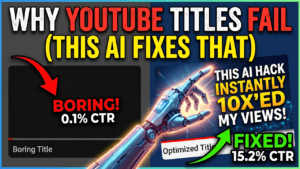
Many YouTube videos fail before anyone has even watched them. That may sound harsh, but it is often true. A creator can spend hours recording, editing and uploading a video, but if the title does not make people want to click, the video can easily be ignored.
In this video and blog post, I want to look at why so many YouTube titles fail and how AI can help creators come up with stronger, more clickable titles. I am not talking about clickbait or misleading people. I am talking about using a better process to create titles that clearly communicate the value of the video.
Recently, I have been making several videos about Sean Cannell’s Video Ranking Academy from Think Media. I have been a member of Video Ranking Academy for over five years, and it is a course that I still refer back to regularly. One of the helpful additions inside the training is the AI title tool, which is designed to help creators think more strategically about their YouTube titles.
Join Video Ranking Academy Here
Why YouTube Titles Matter So Much
A YouTube title is not just a few words added at the end of the upload process. It is one of the main reasons why someone decides whether to click on your video or keep scrolling.
People are busy, distracted and constantly being shown more content than they can ever watch. Your title has to do a lot of work in a very short space of time. It needs to catch attention, communicate the subject, speak to the right viewer and give people a reason to watch.
This is why a weak title can hold back a good video. The content may be helpful, but if the title does not clearly show the benefit, many people will never find out how good the video is.
Why Most YouTube Titles Fail
There are several reasons why YouTube titles fail. One of the most common reasons is that the title is too vague. It may describe the topic, but it does not give the viewer a strong reason to click.
For example, a title like “My Thoughts On YouTube” is too general. It does not tell the viewer what they will learn or why the video matters. A stronger title would be more specific and focused on a clear problem, benefit or curiosity point.
Another reason titles fail is that they are written from the creator’s point of view rather than the viewer’s point of view. The creator knows why the video is useful, but the viewer does not. The title has to bridge that gap.
A third problem is that many titles are created as an afterthought. The video is recorded, edited and uploaded, and then the creator quickly types in a title. That approach can work occasionally, but it is not a reliable strategy if you want to grow your YouTube channel.
The Problem With Guessing Your Titles
Many creators simply guess their titles. They may use the first thing that comes into their mind, or they may copy a format they have seen elsewhere. Sometimes that works, but it can also lead to titles that are bland, confusing or too similar to everyone else’s.
This is where AI can be useful. AI is not a replacement for your own thinking, experience or judgement, but it can be an excellent brainstorming tool. It can help you see angles that you may not have considered and give you a range of title options to work from.
I have said before that AI is not always ideal for creating final content without human input. However, for brainstorming, planning and generating ideas, AI can be extremely helpful. I also use tools such as ChatGPT in my workflow, and I have shared more about that in my post on how I use ChatGPT Projects to manage real work.
Using Think Media’s AI Title System
Inside Video Ranking Academy, Think Media has an AI title system called “Create My Next Video Title.” The purpose of the tool is to help you create a stronger YouTube title by asking the right questions first.
That is important because a good title does not come from a random phrase. It comes from understanding the video topic, the audience, the goal of the video and the style of the content.
The tool asks questions such as:
- What is your video topic?
- What style of video are you creating?
- Is it a short-form or long-form video?
- What is the goal of the video?
- Who is your ideal viewer?
Those questions help the AI understand the context of the video before suggesting titles. This is much better than simply asking AI to “write me a YouTube title,” because the tool is working from a clearer strategy.
A Real Example Using Wealthy Affiliate
In the video, I used a real example based on Wealthy Affiliate. I have been a member of Wealthy Affiliate for almost 12 years, so I wanted to create a title for a longer-form video about getting the best out of the platform and why internet marketers may want to join it.
The video idea was not just a quick review. It was more of a story and value breakdown based on many years of experience. The ideal viewer would be someone who wants to earn money online, work from home and find a practical way to get started.
After entering that information, the AI tool started to identify the likely audience awareness level. It understood that the viewer may already be interested in making money online but may not know which platform to join. That is a valuable distinction because it changes the type of title that may work best.
For example, someone who has never heard of Wealthy Affiliate may respond to one type of title, whereas someone already researching Wealthy Affiliate may respond to a more direct review-style title.
I have written about Wealthy Affiliate several times before, including why I have stayed at Wealthy Affiliate for 11 years and my Wealthy Affiliate review after 11 years. Those posts are useful examples of how long-term experience can give extra credibility when creating content.
Why Experience Makes A Title Stronger
One of the strongest points in my example was the length of time I have been a Wealthy Affiliate member. Almost 12 years is not a small detail. It gives the title more authority because it shows long-term experience.
A title such as “Is Wealthy Affiliate Worth It?” may be useful, but it becomes stronger when it includes the fact that it is coming from someone who has been inside the platform for over a decade.
That is why the AI suggested ideas around a 12-year member review. This kind of title can work well because it combines curiosity, credibility and relevance. It also gives the viewer a reason to trust the content more than a quick review from someone who has only just signed up.
Good Titles Are Not About Clickbait
There is a big difference between a strong title and a misleading title. A strong title makes the viewer want to click because it clearly communicates value. A misleading title makes promises the video does not deliver.
Creators should avoid clickbait because it damages trust. If people click on your video and feel misled, they are unlikely to watch for long or come back again. YouTube also pays attention to how people respond after clicking, so a title that gets clicks but disappoints viewers may not help in the long term.
A good title should create interest, but it should also accurately represent the video. That is where a tool like this can be useful. It helps you explore stronger wording while still keeping the title connected to the real content.
Matching The Title With The Thumbnail
Another useful feature of the AI title system is that it can suggest thumbnail pairing ideas. This matters because the title and thumbnail work together.
The title should not simply repeat the thumbnail text word for word. Instead, the two should support each other. The title can give the main promise or question, while the thumbnail can add curiosity, contrast or emotion.
For example, with a Wealthy Affiliate review, the title might mention the 12-year experience, while the thumbnail could use a short phrase such as “Still Worth It?” or “12 Years Later.” The title gives the context, while the thumbnail makes the idea stand out visually.
I have also written about using AI for visual content, including how to create a YouTube thumbnail using ChatGPT. Titles and thumbnails are closely connected, so it makes sense to think about them together rather than treating them as separate tasks.
Why AI Is Helpful For Brainstorming
One of the best uses of AI is brainstorming. It can quickly generate different angles, headlines and approaches that you may not have thought of on your own.
That does not mean you should simply accept the first suggestion. The best approach is to use AI as a starting point. Look through the ideas, choose the strongest ones, adjust them in your own voice and make sure they accurately reflect the video.
In many cases, the first AI title may not be perfect, but it can lead you toward a much better final title. It gives you something to work with, rather than staring at a blank screen.
Going Deeper With Title Optimisation
In the video, I asked the AI tool to optimise the title specifically for affiliate conversions. This is important because not every YouTube video has the same goal.
Some videos are designed mainly for views. Others are designed to build trust, generate leads, promote an affiliate product or answer a specific search query. The best title depends on the purpose of the video.
If the goal is affiliate conversions, the title should attract people who are genuinely interested in the product, course or platform being discussed. It is better to attract a smaller number of qualified viewers than a large number of people who have no real interest in the subject.
This is especially true for topics such as Video Ranking Academy, Wealthy Affiliate and online business. The right viewer is not just someone who wants entertainment. The right viewer is someone who is seriously looking for a solution.
Video Ranking Academy And YouTube Growth
One of the reasons I continue to talk about Video Ranking Academy is that it covers many important areas of YouTube growth. Titles are only one part of the process, but they are a very important part.
The course also covers strategy, thumbnails, audience, ranking, content planning and building a channel properly. I have been inside the course for over five years, and one of the benefits is that it continues to be updated.
I have shared more about this in my post, how do you get more from Video Ranking Academy? I have also written about how to find your perfect YouTube niche in 2026, which connects closely with title creation because the clearer your niche is, the easier it becomes to create focused titles.
The Importance Of Knowing Your Viewer
A title works best when it speaks directly to the right person. That is why knowing your ideal viewer matters so much.
If you are creating videos about online business, your viewer may be someone who wants to work from home, build a side income, leave a job, start affiliate marketing or learn how to create content. Each of those viewers may need a slightly different title angle.
For example, a beginner may be attracted to a title about starting from scratch. Someone with more experience may respond better to a title about avoiding mistakes, improving conversions or choosing the right platform.
This is why broad titles often struggle. They try to appeal to everyone, but they do not speak strongly to anyone. A more focused title can often perform better because it connects with a specific need or desire.
Why You Should Not Leave Titles Until The End
One useful lesson for any creator is to think about the title before recording the video. You do not always need the final title before you start, but you should have a strong idea of the angle.
If the title is clear before you record, the video is usually more focused. You know what promise you are making to the viewer, and you can make sure the content delivers on that promise.
This is also helpful when creating longer videos. A 20 to 30-minute video needs structure, and the title can help guide that structure. If the title promises a review, the video should review. If the title promises a tutorial, the video should teach. If the title promises a story, the video should tell the story clearly.
Practical Tips For Better YouTube Titles
Here are a few practical points to remember when creating YouTube titles:
- Make the title clear enough that people understand the subject quickly.
- Give the viewer a reason to click.
- Use curiosity carefully, without misleading people.
- Think about the viewer’s problem, desire or question.
- Use your experience or credibility when it is relevant.
- Make sure the title and thumbnail work together.
- Create several title options before choosing the final one.
- Use AI as a brainstorming tool, not as a replacement for your own judgement.
AI Does Not Replace The Creator
There is a lot of talk about AI replacing people, but I do not see it that way when it comes to content creation. AI is a tool. It can help with ideas, structure and speed, but the creator still needs to bring experience, judgement and personality.
Your own story matters. Your own experience matters. Your own way of explaining things matters. AI can suggest titles, but it cannot replace the trust that comes from real experience.
This is especially important in areas such as affiliate marketing and online business. People do not only want information. They want to hear from someone who has actually used the tools, made mistakes, learned lessons and stayed with the process.
Final Thoughts
Most YouTube titles fail because they are too vague, too rushed or too focused on the creator rather than the viewer. A better title starts with a better understanding of the video, the audience and the goal.
The AI title system inside Video Ranking Academy is a useful tool because it asks strategic questions before suggesting titles. It helps you think through the topic, the viewer, the video style and the purpose of the content.
Used properly, AI can help creators come up with stronger titles, better thumbnail ideas and clearer video angles. It is not about replacing your own thinking. It is about giving you a better starting point and helping you make smarter decisions.
If you are serious about growing on YouTube, it is worth spending more time on your titles. A strong title will not fix a poor video, but a weak title can definitely hold back a good one.
If you have any questions about Video Ranking Academy, YouTube titles, AI tools or building an online business, feel free to leave a comment below.