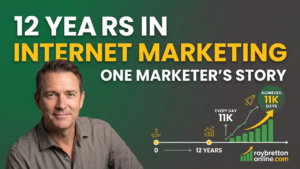
The title of my blog post today is “12 years in internet marketing – one marketer’s story”. Can you really build a successful online business, and what does the journey actually look like behind the headlines? I recently sat down with internet marketer Nick Wood to talk about his journey into digital marketing. We discussed the successes he has experienced, the mistakes he has made and some of the lessons he has learned along the way. One thing that initially caught my attention was the fact that Nick has experienced an £11K day. However, I certainly didn’t want this interview to become another unrealistic “make money overnight” conversation.
In fact, the £11K day is only a small part of a much bigger story. Nick has spent years learning digital marketing, experimenting with different business models and investing in training. He has also experienced opportunities that worked extremely well for a while and then disappeared when platforms changed direction. What came across strongly during our conversation was that building an online business is rarely a straight journey from A to B. You learn, take action, make mistakes, change direction when necessary and keep moving forward.
How Nick Wood Started In Internet Marketing
Nick did not begin his working life as an internet marketer. His background was actually in accounting and healthcare, and for many years he worked in Germany providing services connected with the British military community. Life was going well, but circumstances changed when the British government decided to withdraw troops from Germany. Nick could have remained there until the end and taken redundancy, but instead he and his wife decided to return to the UK and start the next chapter of their lives.
At the age of 48, Nick knew that he didn’t particularly want to spend another 20 or 30 years working in accounting. Interestingly, his first idea had nothing to do with affiliate marketing or digital products. After seeing how many sausages were being sold from stalls at German Christmas markets, his accounting brain started calculating the potential profits. His original plan was therefore to return to the UK and start making and selling sausages at local markets.
The sausage business didn’t develop as expected, but something important came out of the idea. Nick realised that he would need a website, so he bought a domain and started learning how to build one. He freely admits that the website wasn’t particularly attractive, but he managed to get it ranking above a local award-winning butcher. That result helped him recognise just how powerful the Internet could be for generating traffic and attracting customers.
I can relate to that experience because I also recognised the potential of the Internet many years ago. Once broadband made the Internet genuinely usable, it became obvious to me that we had an incredibly powerful business tool available. A relatively simple website can potentially reach people across the world, something that would have been almost unimaginable for a small business a generation earlier. I talk more about this in my article on the power of the Internet.
Learning The Skills Of Digital Marketing
Nick’s interest eventually led him to an Internet marketing event run by Simon Coulson and the Internet Business School. He subsequently joined their training programme and completed a diploma covering a wide range of digital marketing skills. These included email marketing, website building, video marketing and affiliate marketing. He later continued his education with DigitalMarketer and Google, gaining certifications covering subjects such as paid advertising, social media and analytics.
There was also an important lesson in all that training. Digital marketing is an enormous subject, and trying to learn everything at once can become overwhelming. Beginners often believe they need to master websites, SEO, email marketing, social media, paid advertising, video and everything else before they can make progress. In reality, it usually makes far more sense to understand the fundamentals, choose a direction and develop your skills as your business grows.
If you are completely new to online business, my article on how to start building an online business explains some of the foundations. You don’t need to understand every aspect of Internet marketing before you begin. What matters is starting with a sensible foundation and then learning through experience.
Your Website Doesn’t Have To Be Perfect
One interesting part of our conversation concerned website design. Nick openly admits that creating beautiful websites has never been his greatest strength, but he understands something far more important. A business website needs to work. It needs to attract the right visitors, provide useful information and help people find what they are looking for. A visually impressive website that nobody visits isn’t particularly useful to a business.
We mentioned Amazon during the conversation because it provides a good example. Amazon is hardly the most beautiful website on the Internet, but nobody can question its effectiveness. This is particularly relevant for people starting an affiliate marketing business. You don’t need an expensive website filled with complicated effects. A straightforward site containing genuinely useful content can be far more effective, especially when that content answers the questions your potential visitors are already asking.
When Everything Suddenly Changed
Nick went on to build websites and run advertising campaigns for service-based businesses. Then the shutdowns arrived and much of that work suddenly stopped. Because he was effectively operating as a one-man business, there wasn’t much financial support available to him. It was a difficult period, but it also reinforced an important business lesson: relying entirely on one income stream can leave you extremely vulnerable when circumstances suddenly change.
Fortunately, Nick had already been producing a live-stream programme for a real estate broker in Los Angeles. He therefore understood the technology and already had access to the necessary software. During lockdown, he decided to use those skills to help local businesses. His idea was simple. He would hold a daily Facebook Live session where business owners could explain whether they were still operating and tell people how they could continue buying their products or services.
What Do You Do When Everybody Says No?
Nick walked along his local high street explaining the idea to business owners and asking whether they would like to participate. The response was hardly encouraging because nobody was interested. It would have been very easy to decide that the idea was rubbish and forget about it. Instead, Nick decided that he believed in the idea and was going to do it anyway, even if initially there was hardly anybody to interview.
For the first few days, he effectively broadcast to very few people. What he didn’t realise was that Facebook was beginning to give his broadcasts considerable reach behind the scenes. Eventually, a woman who ran a Facebook group containing around 2,500 Berkshire business owners discovered what he was doing. She offered to tell her community about the programme, and suddenly Nick went from struggling to find guests to having numerous business owners interested in appearing.
I think this is one of the strongest lessons from the entire interview. We often judge an idea far too quickly because we can’t immediately see the results. Sometimes things are happening behind the scenes that we simply don’t know about yet. Had Nick stopped after those initial rejections, he would never have discovered where the idea could lead. Sometimes you need to be persistent enough to continue even when the early signs aren’t particularly encouraging.
Why People Give Up On Internet Marketing Too Quickly
This brought us naturally to one of the biggest problems I see in Internet marketing: unrealistic expectations. People are constantly exposed to headlines suggesting that an online business can produce substantial income almost immediately. They may then start a website, publish some content or join an affiliate programme and become disappointed when they haven’t created a full-time income within a few weeks.
I recently spoke to someone who had made his first online sale after approximately five weeks, yet he was disappointed because he felt the business wasn’t working. My reaction was completely different. I thought making a first sale within five weeks was a very encouraging result. If someone has proved that another person is prepared to click their link and make a purchase, they have demonstrated that the basic process can work. The next challenge is learning how to repeat it and improve the results.
Nick had a similar experience when he made one of his first affiliate commissions through Amazon. The commission was only around one dollar, but he was delighted. The amount wasn’t important because that first commission proved the principle. If you can generate one genuine sale online, you can start working towards the second and third. For anyone who is new to the business model, my guide to affiliate marketing explains how the process works.
Nick’s Experience With The Amazon Influencer Programme
Another interesting chapter in Nick’s journey involved the Amazon Influencer Programme. Through people he had met while live streaming, he heard about the opportunity and discovered that he had actually applied around six months earlier. He had completely forgotten about the application, but when he checked his account, he discovered that Amazon had already approved him for the programme.
For around a year, Nick was able to live stream on Amazon and demonstrate products such as webcams, microphones and other technology. His live streams could appear directly on relevant product pages, and Amazon was providing significant exposure. Although the individual affiliate commissions were small, the volume of products being sold made the opportunity worthwhile. Nick became one of a relatively small group of influencers who were actively broadcasting multiple times per day.
Eventually, Amazon changed the way it wanted the programme to operate. The company was more interested in large influencers bringing their existing audiences to Amazon than smaller creators relying on Amazon to provide the traffic. The exposure declined and the opportunity became much less attractive. Nick adapted again and began looking more seriously at digital products, where the affiliate commissions could be considerably higher.
Never Build Everything On Somebody Else’s Platform
The Amazon experience illustrates an important lesson for anyone building an online business. Facebook, Amazon, Google, YouTube and other major platforms can provide fantastic opportunities, but ultimately they control their platforms. Algorithms change, commission structures change and programmes can disappear altogether. Something that produces excellent results today may work very differently next year.
This is one of the reasons I continue to believe strongly in having your own website. Social media and other platforms can be excellent ways of reaching people, but your website gives you an online asset over which you have considerably more control. Ideally, the different parts of your online business should work together rather than leaving you completely dependent on one external platform.
Moving Into Digital Products And Higher Commissions
When the Amazon opportunity became less attractive, Nick started looking more seriously at digital products, master resale rights and affiliate programmes offering higher commissions. Digital products can often provide much larger commissions than physical products because there aren’t the same manufacturing, storage and distribution costs. Of course, that doesn’t mean every digital product is worth promoting. The product still needs to provide genuine value and be suitable for your audience.
This change in direction eventually became an important part of Nick’s business and contributed to some of his strongest results. His story demonstrates why being willing to adapt is so important. He didn’t simply decide that Amazon had changed and therefore Internet marketing no longer worked. He looked at what he had learned, considered the other opportunities available and moved in a different direction.
What About Nick’s £11K Day?
Yes, Nick really has experienced an £11K day, which naturally sounds impressive. However, the important part of the story is everything that happened before that day. It wasn’t the result of discovering a secret button or buying a course on Friday and becoming wealthy by Monday. It came after years of learning, experimenting, investing in education, making mistakes and continuing to take action when individual opportunities stopped working.
Nick certainly doesn’t claim that he makes £11,000 every day. During our conversation, he also mentioned someone he knows who had an exceptionally successful month of around $30,000. That person doesn’t necessarily repeat that exact figure every month either. Business results fluctuate, whether you’re working online or offline. There will be excellent days, average days and days when very little happens.
This is why I think large income figures need to be put into context. They demonstrate what can be possible, but they shouldn’t be presented as normal overnight results for beginners. If you would like to understand the process in more detail, I explain it further in How Making Money Online Really Works.
Treat Your Online Business Like A Real Business
Nick and I also discussed something that I believe is frequently overlooked. Because an online business can be started relatively cheaply, people sometimes don’t take it seriously enough. If somebody invests £50,000 into opening a conventional business, they will normally turn up every day, solve problems and work hard to make that investment succeed. They are unlikely to abandon the whole project because they had a disappointing week.
Compare that with an online business where someone might spend £50 or £500, work at it occasionally for a few weeks and then announce that Internet marketing doesn’t work. Ironically, one of the greatest advantages of an online business can also become a disadvantage. The low barrier to entry means people can start very easily, but it also means they can walk away just as easily.
I know the difference from personal experience. When I set up my last offline business in 2016, it cost me around £35,000 even though I already owned some of the equipment I needed. Had I been starting completely from scratch, the cost could easily have been considerably higher. I also had no guarantee of customers simply because I had spent that money. I still had to go out and make the business work.
By comparison, the financial barrier to starting an online business can be remarkably low. You can purchase a domain name, arrange hosting and start creating content without investing tens of thousands of pounds. My article on how to start making money online with $0 looks at how little you actually need to begin. Low start-up costs don’t mean there is no work involved, though. You still have to treat what you’re doing seriously.
Be Careful Where You Spend Your Money
Nick has invested substantial amounts of money in training throughout his Internet marketing career. Some of those investments were extremely worthwhile, while others were disappointing. He mentioned paying around £6,000 for his early Internet marketing education and felt that it represented good value. On another occasion, he spent around $25,000 on a programme that turned out to be a very poor experience.
That doesn’t mean expensive coaching or training should always be avoided. Nick still invests in coaching because he believes there is value in learning directly from somebody who has already achieved the result he wants. Good coaching can shorten the learning curve and help you avoid unnecessary mistakes. The important thing is to research carefully, understand what you are buying and never assume that a large price tag automatically guarantees quality.
Equally, beginners shouldn’t feel that they need to spend thousands before they can start. There is an enormous amount that can be learned at very little cost. Start with the fundamentals, gain some experience and understand what direction you want to take. You can then make better decisions about where additional training or coaching might genuinely help you.
Avoid The Get-Rich-Quick Mentality
Both Nick and I have been around Internet marketing long enough to remember countless headlines promising turnkey profits, instant income and push-button riches. The terminology changes over the years, but the underlying message is often the same. People are encouraged to believe that somebody has discovered a shortcut that removes the need to learn the skills of running a business.
The reality is much less exciting but considerably more useful. You need to learn, apply what you learn, test things and improve. Some ideas will work and others won’t. When something fails, successful business people don’t normally decide that business itself doesn’t work. They look at what happened, make adjustments and try something different.
One of the biggest mistakes people can make is constantly jumping to the next opportunity because the current one hasn’t produced immediate results. Every new system then takes them back to the beginning of another learning curve. In many cases, they would make far more progress by concentrating on one sensible business model and becoming genuinely competent at it.
The Digital Income Freedom Hub
Nick has created the Digital Income Freedom Hub on Skool, which is a free community for people interested in creating an online income. The idea is to provide somewhere people can learn, ask questions and get help when they become stuck. There is free training available inside the community as well as some paid options for people who want additional training.
I recently joined the community myself and like the straightforward nature of the Skool platform. One of the benefits of joining a community is being able to communicate with people who are actually building online businesses rather than trying to work everything out alone. There will always be times when you become stuck, particularly when you’re learning something new, and sometimes a simple answer from somebody with more experience can save hours of frustration.
Join Nick’s Digital Income Freedom Hub:
Visit The Digital Income Freedom Hub
The Biggest Lesson From Nick’s Journey
If I had to take one central message from my conversation with Nick, it would be the importance of continuing to learn while continuing to take action. His journey has included accounting, website building, SEO, digital marketing qualifications, paid advertising, Facebook Live, Amazon influencing, affiliate marketing, digital products and coaching. Not everything worked forever, and some things didn’t work at all, but each stage provided knowledge that could be used at the next stage.
That is a much more realistic picture of entrepreneurship than the idea that successful people somehow get everything right first time. They don’t. They make mistakes, experience setbacks and sometimes spend money on things they later wish they hadn’t bought. The difference is that they learn from those experiences rather than allowing them to become the reason they stop.
Final Thoughts
I thoroughly enjoyed speaking with Nick, although the interview didn’t go quite according to my original plan. I had prepared ten questions, but Nick’s answer to the first question developed into such an interesting account of his Internet marketing journey that we barely touched the remaining questions. Sometimes that’s exactly how a good conversation should work, and I think we will need to arrange another interview to cover some of the subjects we didn’t reach this time.
If you’re just starting an online business, don’t compare your first few weeks with somebody else’s results after many years. Don’t assume you’ve failed because your first commission was only a few pounds, and don’t panic when something that worked yesterday stops working tomorrow. Learn the fundamentals, surround yourself with people who are genuinely moving forward and keep taking consistent action. You might also find my article on the questions I ask after more than 20 years online useful when deciding where to focus your efforts.
Most importantly, remember that an online business is still a business. The financial barrier to entry may be dramatically lower than opening a traditional business, but the basic principles haven’t changed. You need to learn your trade, provide something useful, keep improving and give yourself enough time for your efforts to produce results. Nick’s £11K day is certainly an impressive part of his story, but the years of learning and persistence that came before it are probably the more valuable lesson.
Watch My Full Interview With Nick Wood
You can watch my full conversation with Nick Wood above or directly on YouTube, where we discuss his journey from accounting into digital marketing, his experiences with Facebook Live and Amazon, his move into affiliate marketing and the reality behind that £11K day. If you are building an online business yourself, I think you will particularly appreciate Nick’s straightforward approach to the successes and setbacks he has experienced along the way.
If you enjoyed the interview, please leave a comment and let me know about your own experience. Have you made your first affiliate commission yet, and if so, can you remember how it felt? Perhaps you’re still working towards that first sale. Either way, I’d be interested to hear where you are on your own Internet marketing journey